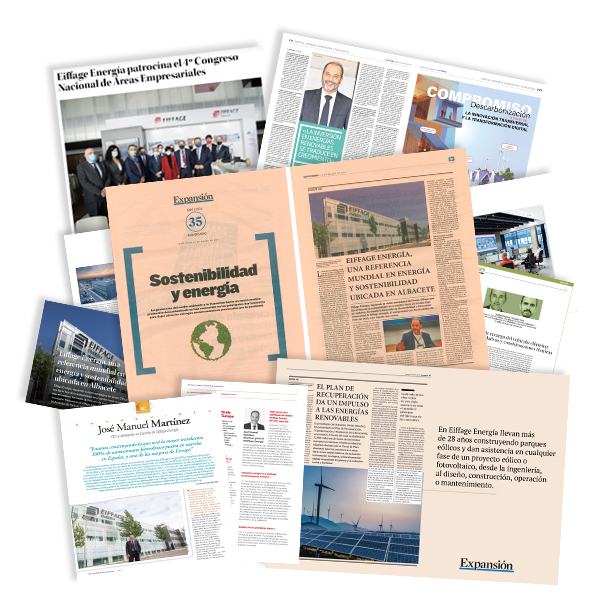
José Manuel Martínez, CEO of Eiffage Energía Sistemas and Eiffage’s representative in Spain and Portugal, joined Onda Cero’s ‘Más de Uno Albacete’ programme to look back on the company’s journey since its beginnings, take stock of the energy sector today and outline the technical profiles it needs to bring on board in order to grow.
Albacete: past, present and future
The conversation opened with the historical weight that the city of Albacete has carried, still carries and will keep carrying for Eiffage Energía Sistemas. “Albacete is where we come from. This is where it all began for Eiffage in Spain,” he said.
It all started with the acquisition of Electrosur 21, an Albacete-based company that was then turning over €24 million and employing 200 people. Expansion followed from there.
Growth, the CEO explains, has come by two routes: “We have grown organically, through internal development, but also by bringing in very strong, major companies from the sector.”
Castilla-La Mancha, epicentre of strategic projects
Eiffage Energía Sistemas is consolidating its place as a structural pillar of economic, industrial and energy development in Castilla-La Mancha. By taking part in large-scale strategic projects, the company strengthens the region’s role as a key driver of the energy transition and industrial innovation in Spain.
Asked about these projects, Martínez gave three examples:
- Albacete University Hospital Complex. We are involved in all the electromechanical and fire protection installations
- Fassa Bortolo factory, in Tarancón. “One of the biggest in Europe,” he pointed out.
- Expansion of the Airbus plant.
Delivering projects like these shows that Eiffage Energía Sistemas can lead innovative developments shaped around the energy and environmental challenges ahead for Castilla-La Mancha.
The energy sector today
José Manuel Martínez also took stock of the energy sector today. One of the most technical parts of the conversation centred on large-scale storage, or BESS (Battery Energy Storage Systems).
Martínez describes these systems as “an essential technological element” if renewable generation is to be viable.
Battery energy storage plays a crucial role in harnessing renewable energy: it stores the surplus produced by intermittent sources such as wind and solar, then releases it when demand calls for it.
The result is a more stable grid and greater energy security in the face of extraordinary or unforeseen events, such as demand peaks caused by extreme weather, blackouts or other emergencies.
The challenge of artificial intelligence
Spain’s electricity demand rose by 2.8 per cent in 2025, according to Red Eléctrica, against a European average of 0.5 per cent. It reflects an economy that is electrifying, and the trend is pointing upwards. Data centres linked to artificial intelligence already hold more than 6,300 MW of granted grid access capacity, a third of the total, even though none of them is in service yet. That leaves the electricity system with a twofold challenge: expanding generation capacity and making sure that energy arrives when it is needed.
For Martínez, this is one of the sector’s main challenges. Artificial intelligence, he explains, is reshaping the country’s energy needs and forcing a rethink of demand forecasts.
Yet the same technology also points to an answer. It allows the different generation assets to be managed with greater agility and efficiency, by day and by night, complementing conventional generation.
The CEO ties this to the international context, which is moving towards greater energy independence: “Spain and Castilla-La Mancha have abundant renewable resources with which to reduce their dependence on fossil fuels,” he said.
Commitment to decarbonisation
On decarbonisation, José Manuel Martínez insists on consistency within the company. “We have a very clear and very demanding goal: to reach net zero emissions by 2050. But we have broken that goal down into very specific interim targets, such as cutting our internal emissions by 46 per cent and our external emissions by 30 per cent by 2030.
In fact, we have already reduced our emissions intensity by more than 34 per cent against our base year. So we’re not talking about intentions; we’re talking about results.”
He adds that suppliers are held to the same standard, closing what he called a “360-degree circle” across everything the company does.
In search of talent
Our 2026–2030 Strategic Plan aims for a workforce of 10,000. In the interview, Martínez stated: “The growth of Eiffage Energía Sistemas is leading us to recruit professionals with solid technical training, mainly engineers and technical profiles linked to our areas of activity.”
Beyond technical knowledge, we are giving more and more weight to soft skills: we look for professionals who can adapt, take the initiative, communicate, work in a team, lead, focus on results, think critically, negotiate and keep learning.
In a sector that moves this fast, we need curious people who can learn continuously and, above all, approach new challenges with an open attitude and work collaboratively.
As he summed up, these are “high-level technology profiles” that are in very strong demand on the labour market.